
Every athlete, at every level, eventually gets a break. A season ends. The body heals. Training resets. First responders don’t get that. There is no off-season for a firefighter, a patrol officer, or a paramedic. Every shift is game day, and the body is never given the predictable downtime it needs to fully recover before the next one starts.
That single structural difference, the absence of an off-season, is one of the most overlooked drivers of injury, cardiovascular risk, and early retirement in public safety. And for the leaders and wellness coordinators responsible for managing that risk, understanding how fatigue accumulates is the first step toward controlling what it costs.
Stress Doesn’t Discriminate
Ben Jacobs, founder of Frontline Human Performance, put it plainly during a recent CoachMePlus webinar: the body doesn’t separate one kind of stress from another. A hard workout, a bad night of sleep, a rough call, a custody dispute, mandatory overtime. To the nervous system, it’s all the same input. It all adds to the same total load.
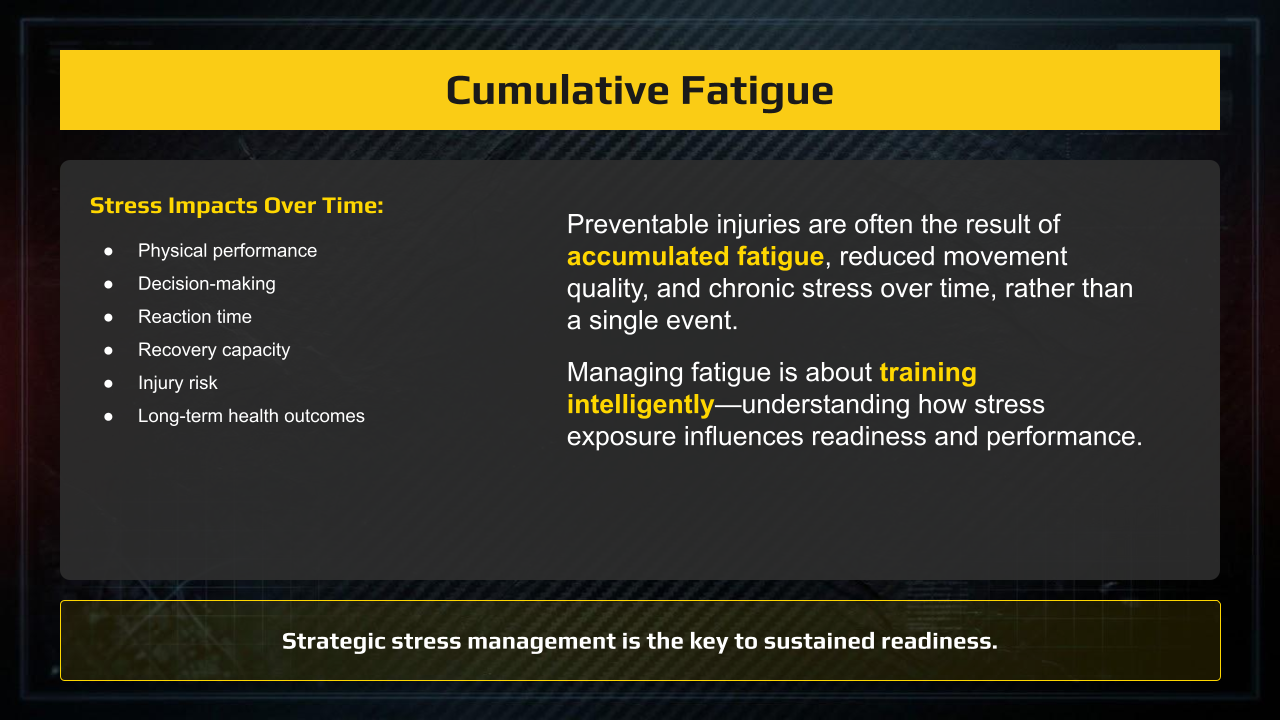
That matters because most departments still think about fitness and injury risk in terms of workouts alone. But cumulative fatigue isn’t built exclusively in the gym or on the fireground. It’s built from every source of stress a person carries, on and off the clock, and it compounds quietly until something gives.
An injury that shows up today is rarely caused by one bad moment. It’s often the result of fatigue that has been accumulating for weeks or months, degrading the way a person moves and recovers, long before anyone noticed a problem.
The Sympathetic Nervous System Never Gets a Break
First responders spend an outsized amount of their working lives in a sympathetic, or “fight or flight,” state. That’s the nervous system doing exactly what it’s supposed to do in an emergency. The problem is what happens when someone can’t consistently switch back into a parasympathetic, recovered state between emergencies.
“First responders don’t have that luxury. You are always in season. Every shift is game day.” — Ben Jacobs, Frontline Human Performance
Staying in a sympathetic state too long keeps cortisol and epinephrine elevated. Over time, that pattern drives the metabolic and cardiovascular conditions that hit first responders at disproportionate rates. This isn’t a minor detail. A landmark study in the New England Journal of Medicine found that cardiovascular events cause 45 percent of on-duty firefighter deaths, compared with 22 percent for police officers and 15 percent across all occupations. The U.S. Fire Administration’s 2023 data found that stress and overexertion caused 53 percent of firefighter line-of-duty deaths that year. Fire suppression makes up only a small fraction of total working hours. Yet it’s where most of these cardiac events happen.
None of this is about isolated incidents. It’s about a nervous system that rarely gets the chance to fully reset.
Recovery Is Not a Weakness
One of the more difficult cultural shifts departments have to make is treating recovery as part of training rather than the absence of it. As Ben explained, recovery is still training. The body adapts during recovery, not during the workout itself. Skipping it doesn’t make someone tougher. It just stacks more fatigue on top of what’s already there.
Practical recovery tools include quality sleep, low-intensity aerobic work in the 120 to 140 beats-per-minute range, mobility work, proper hydration and nutrition, and basic stress management. None of these require a large budget or a new facility. What they require is a shift in mindset from leadership on down: a hard training session the day after a high call volume shift may not be the right call. A recovery day might do more for that person’s long-term durability than another workout would.
What This Costs a Department
For fire chiefs, police leadership, and municipal decision-makers, cumulative fatigue isn’t an abstract wellness concern. It hits measurable, budgeted line items.
Unmanaged fatigue drives up soft tissue injuries and overuse conditions. Those generate workers’ compensation claims. The cardiovascular risk documented above carries its own cost, too, in line-of-duty presumption claims and lost personnel. Departments pay overtime to backfill positions for injured or burned-out staff. And years later, veterans retire earlier than they otherwise would have, taking decades of institutional knowledge and training investment with them.
A single fitness test won’t catch any of this. Claims data will catch it. So will overtime budgets and exit interviews, months after the underlying fatigue has already done its damage.
Managing What You Can’t See
Cumulative fatigue hides in plain sight. A person can pass a fitness test while carrying weeks of accumulated stress that puts them at meaningfully higher risk on their very next shift. You can’t see that on paper.
That’s why leading departments now track fatigue continuously instead of periodically. Wearable data and digital engagement tools can flag elevated resting heart rate, poor sleep, or declining recovery trends early. Catch those signals in time, and you catch the problem before it becomes an injury or a cardiac event.
Treat cumulative fatigue as a genuine operational risk, not a personal toughness issue. That’s the first step toward a department-wide strategy that actually reduces claims and preserves the veteran workforce a municipality has already invested so much in building.
Want Ben’s full explanation of how cumulative fatigue builds and how to intervene early? In our recent webinar, The Blueprint for Building Durable First Responders, Ben Jacobs walks through the physiology behind fatigue accumulation, recovery strategy, and how it connects directly to long-term durability for fire, police, and EMS personnel. Coach Mike Gallivan also shares data from the FDNY Cadet Academy pilot program on how consistent engagement and tracking translate to measurable outcomes.
Recent Comments